Kimi K3 vs GPT-5.6 (Sol, Terra, Luna): Verdict (2026)
July 19, 2026 · Updated September 25, 2026 · kimi k3 vs gpt-5.6 · kimi k3 vs gpt-5.6 sol · kimi k3 vs chatgpt · gpt 5.6 sol terra luna
One week. That’s all that separated the two biggest AI launches of July 2026: GPT-5.6 went generally available on July 9, and Kimi K3 launched on July 16. OpenAI’s new flagship, GPT-5.6 Sol, is the model Moonshot measured K3 against in every launch benchmark — and the results make this the closest open-vs-closed race the industry has seen.
But comparing “K3 vs GPT-5.6” isn’t simple, because GPT-5.6 isn’t one model — it’s three (Sol, Terra, Luna), and OpenAI’s flashiest benchmark numbers come from a special Ultra mode that most coverage doesn’t explain. This article untangles all of it: every head-to-head score, the Ultra asterisk, exact pricing across all tiers, independent arena data, and a clear verdict.
Update (Sept 2026): OpenAI has since launched GPT-6 Astra and GPT-6 Sol — for the current flagship matchup, see Kimi K3 vs GPT-6 Astra. OpenAI has also cut GPT-5.6 list prices: as of Sept 25, 2026 its pricing page lists Sol at a promotional $4/$20 per 1M tokens (available at least through Nov 21, 2026), down from the $5/$30 this article originally compared against. The tables below show both. K3’s license, active-parameter count and measured speed were also corrected.
First, understand the GPT-5.6 family
OpenAI changed its naming strategy with this release: 5.6 is the generation; Sol, Terra and Luna are capability tiers that will advance on their own schedules. All three share a 1M+ token context window and 128K max output, distilled from the same base training run but optimized for different price-performance points:
| GPT-5.6 Sol | GPT-5.6 Terra | GPT-5.6 Luna | |
|---|---|---|---|
| Role | Flagship | Balanced everyday | Fast & cheap |
| Roughly equivalent to | New frontier | GPT-5.5 (at half cost) | High-volume tasks |
| Input (per 1M) | $4.00 promo (was $5.00) | $2.00 (was $2.50) | $0.20 (was $1.00) |
| Output (per 1M) | $20.00 promo (was $30.00) | $12.00 (was $15.00) | $1.20 (was $6.00) |
| Reasoning levels | none → xhigh, max, plus Ultra multi-agent | Same levels | Same levels |
| Best for | Complex professional & agentic work | Production workloads | Latency/cost-sensitive volume |
Current prices are OpenAI’s standard short-context rates as listed on Sept 25, 2026; long-context requests cost more (Sol: $8 input / $30 output). “Was” figures are the prices this article cited in July.
The gpt-5.6 API alias routes to Sol. Sol is available fully to ChatGPT Pro subscribers and API users, rate-limited on Plus, and absent from the free tier. Since Kimi K3 is a frontier-class model, Sol is the fair head-to-head — but Terra and Luna matter to this comparison’s pricing math, as you’ll see below.
Kimi K3 vs GPT-5.6 Sol at a glance
| Kimi K3 | GPT-5.6 Sol | |
|---|---|---|
| Maker | Moonshot AI | OpenAI |
| Released | July 16, 2026 | July 9, 2026 (GA) |
| Architecture | 2.8T MoE, 16/896 experts (~104B active) | Undisclosed (closed) |
| Context window | 1M tokens | 1.05M tokens |
| Max output | — | 128K tokens |
| Thinking | low / high / max (max default) | none/low/med/high/xhigh/max + Ultra |
| Input price | $3.00 ($0.30 cached) | $4.00 promo ($0.40 cached); $5.00 at the time of writing |
| Output price | $15.00 | $20.00 promo; $30.00 at the time of writing |
| Cost per benchmark task (July prices) | $0.94 | ~$1.90 |
| Open weights | Yes — released July 27 (Kimi K3 License) | No |
| Free tier | Kimi app has one, but confirmed K3 access needs a paid plan | No (Sol is paid-only) |
The head-to-head benchmarks: K3 wins 5 of 6
Moonshot’s launch suite tested every model at maximum thinking effort, each under its own designated harness (K3 under KimiCode, Sol under Codex):
| Benchmark | Kimi K3 | GPT-5.6 Sol | Winner |
|---|---|---|---|
| Terminal-Bench 2.1 | 88.3 | 88.8 | Sol by 0.5 |
| Program Bench | 77.8 | 77.6 | K3 by 0.2 |
| SWE Marathon | 42.0 | 39.0 | K3 by 3.0 |
| BrowseComp | 91.2 | 90.4 | K3 by 0.8 |
| SpreadsheetBench 2 | 34.8 | 32.4 | K3 by 2.4 |
| Automation Bench | 30.8 | 29.7 | K3 by 1.1 |
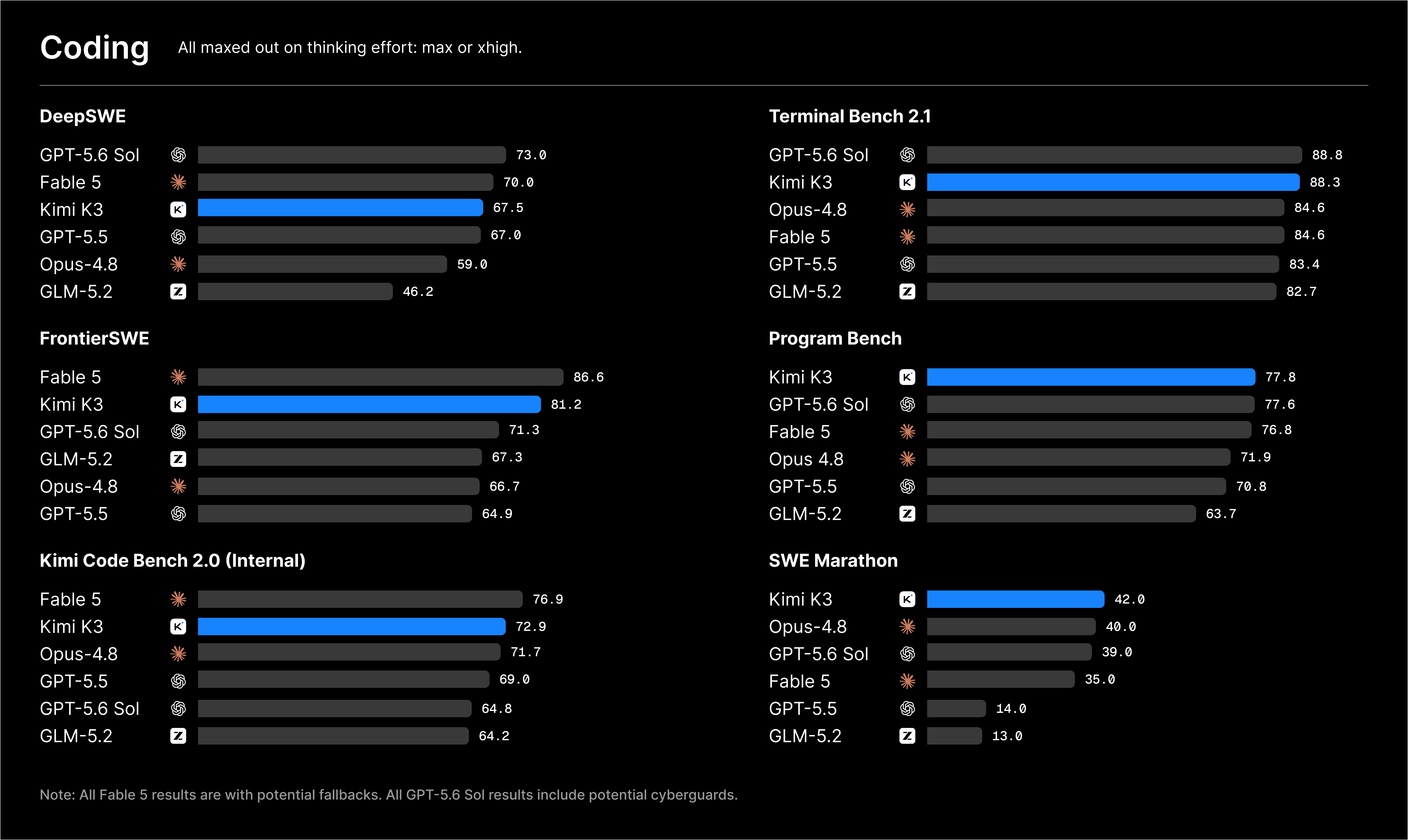
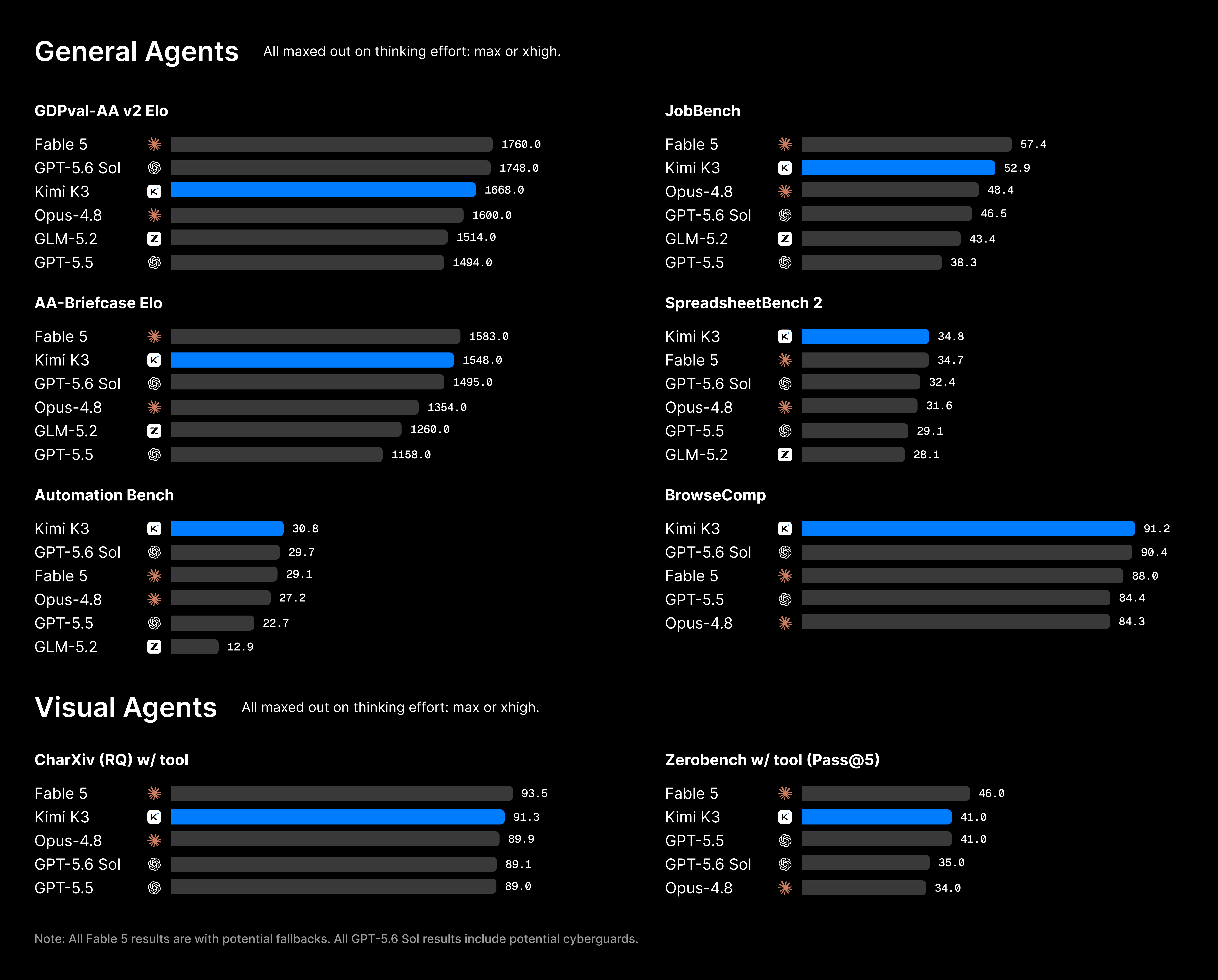
The pattern: Sol’s only win is a 0.5-point edge on Terminal-Bench, while K3’s wins include decisive gaps on SWE Marathon (long-horizon engineering) and SpreadsheetBench 2 (real office work). Two footnotes matter here:
- Sol’s cyberguard activated on 10% of tasks in Moonshot’s KCB 2.0 coding benchmark — OpenAI’s cybersecurity safeguards refused or constrained those runs, dragging its score. If your workloads touch security-sensitive code, this affects production too, not just benchmarks.
- K3’s BrowseComp 91.2 was scored with context compaction at 300K — less than a third of its window. With the full 1M window it scores 90.4–91.2 without any compaction strategy.
The Ultra asterisk you need to understand
OpenAI’s marketing headlines quote higher numbers: 91.9% on Terminal-Bench 2.1 and 92.2% on BrowseComp — both above K3. What’s often missed: those are Sol Ultra results.
Ultra is a multi-agent mode that spins up multiple sub-agents working in parallel, then merges their findings — OpenAI’s own analogy is assigning research, writing, editing and fact-checking to four people instead of one. It’s genuinely powerful, but it’s a fundamentally different (and far more compute-hungry) operating mode. Moonshot’s suite tested standard Sol — the mode priced at $5/$30 at the time (now $4/$20 on promotion) — and against standard Sol, K3 wins 5 of 6.
The fair takeaway: if you let Sol burn significantly more compute per answer via Ultra, it can edge past K3’s single-agent max mode. On equal footing, K3 leads — and K3’s low/high effort modes have since shipped as well.
What OpenAI’s own numbers say (and don’t)
OpenAI reported strong results for Sol on suites where K3 has no published scores yet:
- SWE-bench Pro: 64.6% (vs Fable 5’s 80.3% — interestingly, Anthropic leads here)
- GPQA Diamond: 94.6% graduate-level science reasoning
- OSWorld 2.0: 62.6% computer-use
- DeepSWE: 72.7 (xhigh, with tools)
- Artificial Analysis Coding Agent Index: Sol 80 vs Fable 5’s 77.2 — OpenAI claims SOTA, reached with fewer than half the output tokens, half the time, and a third of the cost of Fable 5
Sam Altman also claims Sol delivers 54% better token efficiency on AI coding tasks versus the previous generation. Until independent testers publish K3 on these same suites, treat this category as “unproven either way” — what’s confirmed is that at launch, on the independent Artificial Analysis aggregate index, K3 (#4 of 189, score 57) sat behind Sol, and Moonshot itself says K3 trails Sol and Fable 5 in overall user experience. AA has since re-versioned the index: on v4.3.2, K3 (max) scores 44 (#3 among large open-weight models), level with the newer GPT-6 Sol (43) and behind GPT-6 Astra (53).
The people’s vote: LMArena
Blind community voting tells a cleaner story than vendor charts:
| Kimi K3 | GPT-5.6 Sol | |
|---|---|---|
| Frontend Code Arena rank | #1 | #3 |
| Elo | 1679 | 1590 |
| Pairwise win rate | 76% | 58% |
K3 jumped 17 places from K2.6 to take #1 — above every closed model, Sol included. On the general Text Arena, though, K3 ranks #9; the closed flagships still own general chat.
Pricing: K3 vs the whole GPT-5.6 ladder
| Per 1M tokens | Kimi K3 | GPT-5.6 Sol | GPT-5.6 Terra | GPT-5.6 Luna |
|---|---|---|---|---|
| Input | $3.00 | $4.00 promo (was $5.00) | $2.00 (was $2.50) | $0.20 (was $1.00) |
| Cached input | $0.30 | $0.40 (was $0.50) | $0.20 | $0.02 |
| Output | $15.00 | $20.00 promo (was $30.00) | $12.00 (was $15.00) | $1.20 (was $6.00) |
| Batch discount | — | 50% | — | — |
Versus Sol at its July prices, K3 was 1.67× cheaper on list prices (about 1.33× against Sol’s current $4/$20 promotional rate) — and the real-world gap is bigger: measured cost per benchmark task at July prices was $0.94 for K3 vs roughly $1.90 for Sol, because Moonshot’s Mooncake inference achieves >90% cache-hit rates in coding workloads, billing most input at the $0.30 tier.
The more interesting fight is K3 vs Terra: Terra matches GPT-5.5-level performance, launched at $2.50/$15 (K3’s exact output price) and now lists at $2/$12. But K3 demolished GPT-5.5 in Moonshot’s suite (SWE Marathon 42.0 vs 14.0; wins on all six). At similar output pricing, K3 delivers frontier-class agentic performance where Terra delivers last-generation performance. Luna (now $0.20/$1.20) undercuts everyone on price but targets high-volume simple tasks — a workload K3 at max thinking isn’t designed for anyway.
One genuine Sol advantage: a 50% Batch API discount for offline workloads, which Moonshot doesn’t offer yet.
Modes, safety and the cybersecurity angle
Sol ships with the most granular control in the industry: six reasoning levels (none → max) plus Ultra multi-agent. K3 launched locked at max thinking effort but has since shipped low/high modes (plus a half-quota k3-256k variant) — today, Sol still gives you more dials (six levels plus Ultra).
Both launches were shaped by cybersecurity politics. Sol’s release was delayed weeks by a US government review (the Commerce Department’s AI Standards center tested it before launch), and OpenAI markets Sol as its “most powerful cybersecurity model” — matching Anthropic’s restricted Mythos preview on ExploitBench with ~3× fewer tokens, positioned for defensive work like threat modeling and blue teaming. Those same safeguards produced the cyberguard refusals seen in benchmarks. K3 takes the opposite philosophy: open weights for everyone since July 27, with the responsibility shifted to deployers.
Ecosystem: convenience vs freedom
Choose Sol’s world if you want: ChatGPT’s polished UX, Codex, the Responses API with web/file search and computer-use tools, ChatGPT Work for office tasks, and OpenAI’s enterprise compliance machine.
Choose K3’s world if you want: the Kimi apps (a free tier for trying Kimi; confirmed K3 access needs a paid plan), Kimi Work’s widgets and dashboards, Kimi Code’s CLI agent, an OpenAI-compatible API at a fraction of the task cost, availability on Amazon Bedrock (GA since Sept 18, 2026) and Microsoft Foundry via Fireworks (every K3 provider) — and since July 27, the weights themselves (Kimi K3 License, MXFP4) for self-hosting and fine-tuning. Sol offers no fine-tuning and will never be open.
Which should you choose?
| Your situation | Pick |
|---|---|
| Agentic coding at production scale (5/6 benchmark wins, cheaper per task) | Kimi K3 |
| Frontend/UI development (#1 Arena, 1679 vs 1590 Elo) | Kimi K3 |
| Terminal-heavy CLI automation | GPT-5.6 Sol (narrowly) or K3 — near tie |
| Maximum reasoning regardless of compute cost | Sol Ultra (multi-agent) |
| Granular reasoning-effort control today | GPT-5.6 Sol |
| GPT-5.5-class workloads at K3’s price | Kimi K3 over Terra |
| High-volume simple tasks | GPT-5.6 Luna |
| Self-hosting, fine-tuning, zero lock-in | Kimi K3 (weights out since July 27) |
| ChatGPT/Codex ecosystem investment | GPT-5.6 Sol |
The low-cost move: K3’s API unlocks after a $1 top-up, which is enough to benchmark it against your real workload before committing real money to either API. (The Kimi app’s free tier is fine for trying Kimi, but Moonshot only confirms K3 access on paid plans; Sol has no free tier at all.)
FAQ
Is Kimi K3 better than GPT-5.6 Sol? On Moonshot’s agentic suite, K3 beats standard Sol on 5 of 6 benchmarks (losing Terminal-Bench by 0.5). Sol’s higher headline numbers (91.9 Terminal-Bench, 92.2 BrowseComp) come from Ultra multi-agent mode, which uses far more compute. On aggregate intelligence rankings, Sol still led at launch; K3 cost about half as much per task at July prices.
What’s the difference between GPT-5.6 Sol, Terra and Luna? They’re capability tiers of the same generation: Sol is the flagship ($4/$20 per 1M tokens on promotion as of Sept 2026, launched at $5/$30), Terra matches GPT-5.5 at lower cost (now $2/$12), and Luna is the fast budget tier (now $0.20/$1.20). All share a 1M+ token context window. K3 competes with Sol on quality.
Is Kimi K3 cheaper than GPT-5.6? Than Sol, yes: $3/$15 vs Sol’s current promotional $4/$20 per 1M tokens ($5/$30 at launch), and at July prices K3 cost roughly half as much per task ($0.94 vs about $1.90) thanks to over 90% cache-hit rates. Terra and Luna are cheaper per token than K3 but target less demanding work, not frontier agentic tasks.
Kimi K3 vs GPT-5.6 Sol for coding? K3 for most teams: it wins SWE Marathon (42.0 vs 39.0), Program Bench, and the community Frontend Code Arena (76% vs 58% win rate) at a lower task cost. Sol keeps a 0.5-point Terminal-Bench edge and the Ultra mode for maximum-effort runs.
Can Kimi K3 replace ChatGPT or Codex? For API-driven agents and coding pipelines — very plausibly, at lower cost, with open weights available for self-hosting since July 27. If your team lives in ChatGPT’s UX or Codex, Sol is the smoother fit. Kimi Code CLI is the closest equivalent to Codex.
Which is safer for enterprise use, K3 or GPT-5.6 Sol? Different models of safety: Sol passed a US government pre-launch review and ships restrictive cyberguards (which can refuse security-adjacent tasks). K3 is open-weight — you control deployment and data never leaves your infrastructure if self-hosted, but you own the responsibility.
The verdict
Kimi K3 vs GPT-5.6 Sol is a genuine split decision — and that alone is historic for an open-weight model. Against standard Sol, K3 wins five of six agentic benchmarks, leads the community coding arena, and cost roughly half as much per task at July prices (Sol’s $4/$20 promotion narrows that). Sol answers with Ultra mode’s multi-agent ceiling, finer control knobs, a 50% batch discount, and the deepest product ecosystem in AI. Terra and Luna fill price points K3 doesn’t target — but at K3’s own price, nothing in OpenAI’s lineup matches K3’s performance.
Also see: Kimi K3 vs Claude Fable 5 (the other flagship fight), the four-way frontier comparison, and the complete Kimi K3 guide.