Kimi K3 vs GLM-5.2: Benchmarks, Pricing & Which Wins
July 25, 2026 · kimi k3 vs glm 5.2 · glm 5.2 vs kimi k3 · kimi k3 vs glm · open weight ai models · ai model comparison
Two weeks before Kimi K3 (July 16, 2026) reset expectations for open-weight AI, GLM-5.2 (June 13, 2026) held the crown: Zhipu AI’s 744B coding-first flagship was the highest-scoring open-weight model ever measured. Now the two Beijing labs go head-to-head — and this is the most important comparison in open-weight AI right now, because both models target the same buyer: teams building agents and coding pipelines who refuse to pay closed-model prices.
The independent verdict is already in, and it splits cleanly: K3 is the stronger model. GLM-5.2 is the more practical one. K3 wins every shared capability benchmark and adds native vision. GLM-5.2 costs a third as much, runs nearly three times faster, and — unlike K3 — its MIT-licensed weights are downloadable today. Here’s every number, plus a clear verdict for each type of team.
The two models at a glance
| Kimi K3 | GLM-5.2 | |
|---|---|---|
| Maker | Moonshot AI | Zhipu AI (Z.ai) |
| Released | July 16, 2026 | June 13, 2026 |
| Parameters | 2.8T MoE (16/896 experts) | 744B MoE (~40B active; 753B per Artificial Analysis) |
| Context window | 1M tokens (1,048,576) | 1M tokens (1,048,576) |
| Max output | Not publicly capped | 131K tokens |
| Modalities | Text + image + video | Text only |
| Reasoning | Always on; low / high / max | High / Max toggle (reasoning_effort) |
| Input price (per 1M) | $3.00 ($0.30 cached) | $1.40 ($0.26 cached) |
| Output price (per 1M) | $15.00 | $4.40 |
| License | Modified MIT (July 27) | MIT — weights live now |
| Self-hosting | 64+ accelerators recommended | Single 8×H200 node (FP8) |
| Output speed | ~62 tok/s | ~168 tok/s |
| AA Intelligence Index | 57 (#4 overall) | 51 (top open-weight pre-K3) |
Pricing: GLM-5.2 is roughly 3× cheaper per task
| Billing tier (per 1M tokens) | Kimi K3 | GLM-5.2 | GLM cheaper by |
|---|---|---|---|
| Input (standard) | $3.00 | $1.40 | 2.1× |
| Input (cache hit/read) | $0.30 | $0.26 | 1.2× |
| Output | $15.00 | $4.40 | 3.4× |
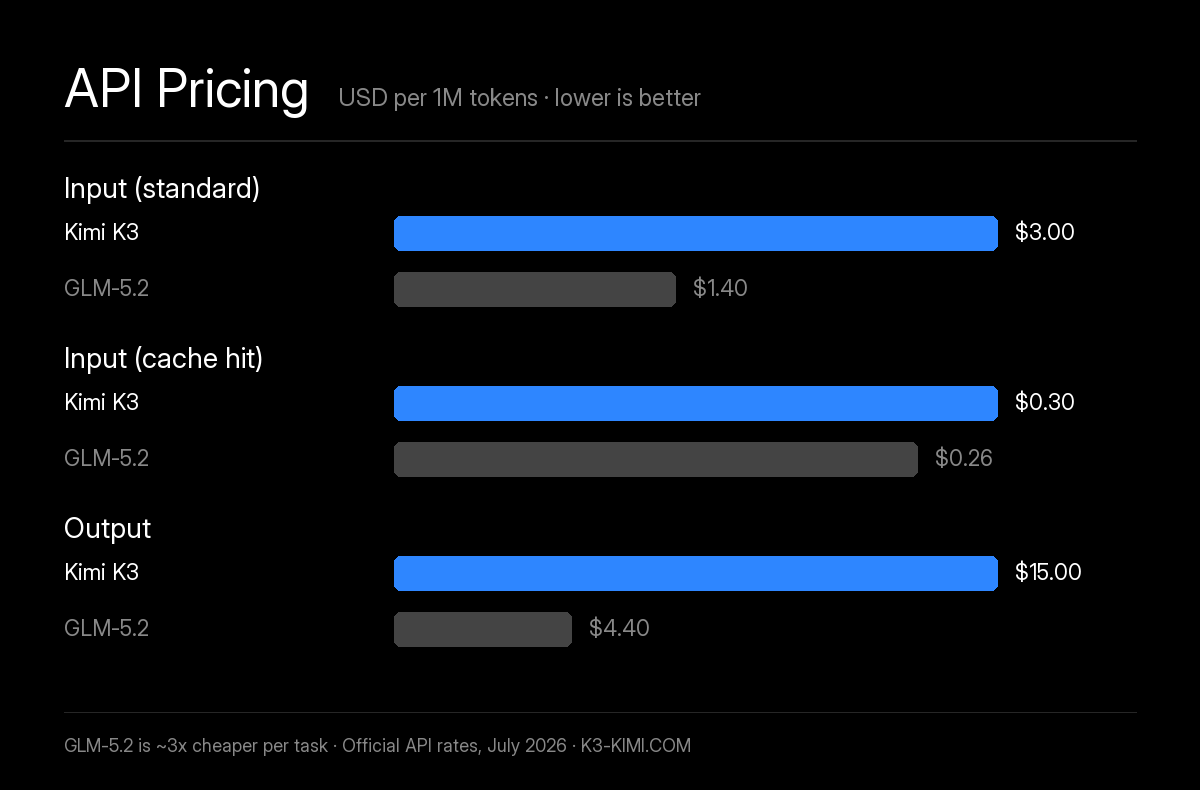
On Artificial Analysis’s blended basis (7:2:1 cached:input:output), that’s $2.31 per million tokens for K3 vs $0.90 for GLM-5.2. The number that matters most — cost per completed task — lands at ~$0.94 vs ~$0.32. One dollar buys roughly 67K output tokens from K3 versus 227K from GLM-5.2. For high-volume agent loops, that 3× gap compounds into a serious budget difference.
K3’s counter: Moonshot’s Mooncake inference stack reports >90% cache-hit rates on coding workloads, pulling most real input bills to the $0.30 tier — and K3 needs fewer retries on hard tasks, which partially closes the per-task gap. GLM-5.2’s counter-counter: its High/Max reasoning toggle cuts token burn 2–2.5× on routine work, while K3’s low/high effort modes only shipped post-launch — though K3’s new k3-256k variant (~half quota for ≤256K workloads) now narrows the cost-control gap. Zhipu also sells GLM Coding Plan subscriptions (from roughly $10–18/month) for predictable-cost coding access, and third-party providers list GLM-5.2 as low as $0.77/$2.42 per million tokens.
Benchmarks: K3 wins every shared test
Moonshot’s launch suite ran both models through matched agentic harnesses — this is the cleanest capability comparison available:
| Benchmark | Kimi K3 | GLM-5.2 | K3 margin |
|---|---|---|---|
| DeepSWE | 67.5 | 46.2 | +21.3 |
| Program Bench | 77.8 | 63.7 | +14.1 |
| Terminal-Bench 2.1 | 88.3 | 82.7 | +5.6 |
| FrontierSWE | 81.2 | 67.3 | +13.9 |
| SWE Marathon | 42.0 | 13.0 | +29.0 |
| Automation Bench | 30.8 | 12.9 | +17.9 |
| GPQA-Diamond | 93.5 | 91.2 | +2.3 |
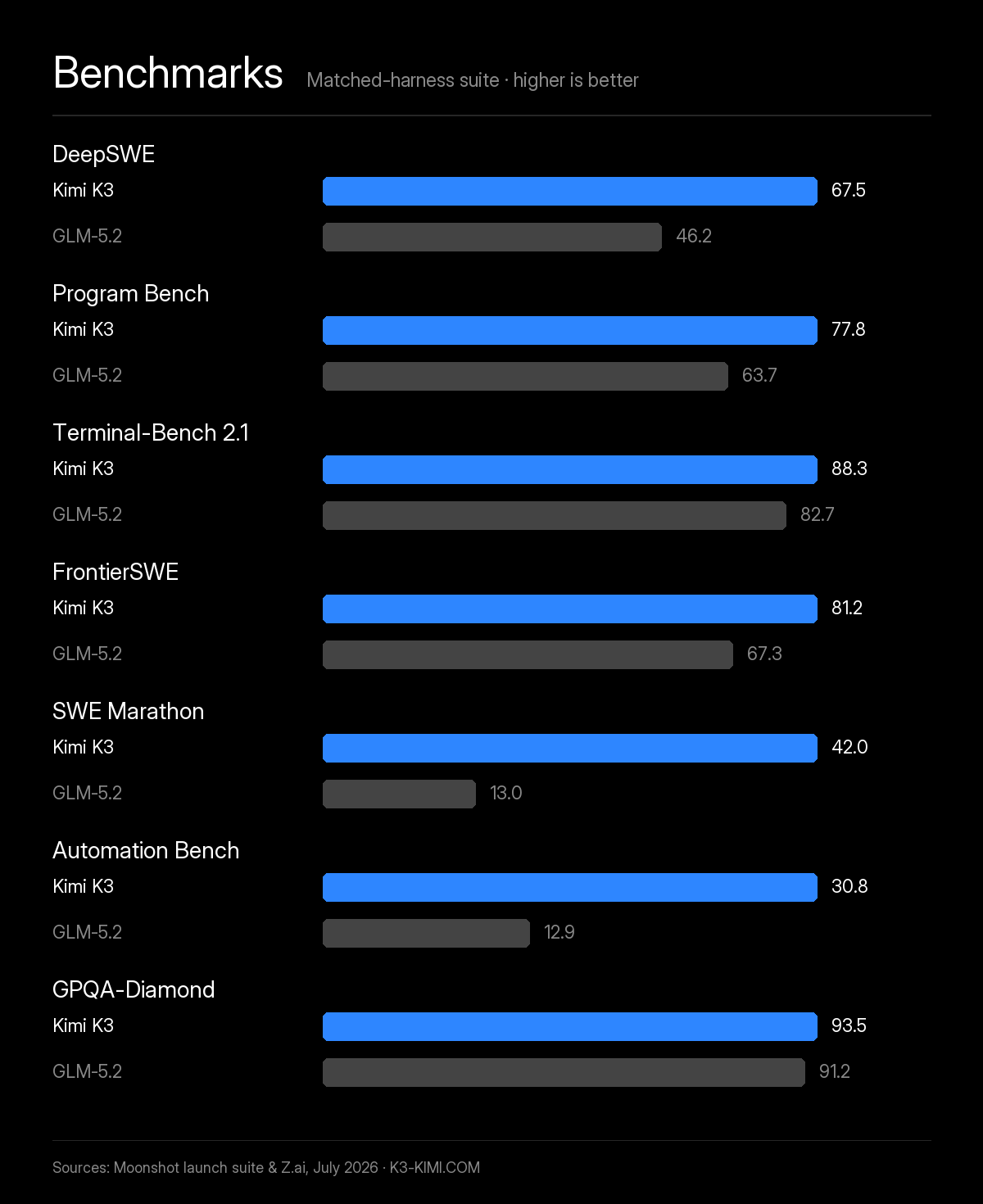
The shape of these numbers matters. On bounded coding tasks (Terminal-Bench, Program Bench) GLM-5.2 stays within striking distance. On long-horizon autonomous work — SWE Marathon, Automation Bench — the gap explodes to 3×+. That’s exactly the workload class K3 was built for, and it’s where GLM-5.2’s smaller active-parameter budget shows.
What independent testing says
Artificial Analysis ran both on its standardized Intelligence Index v4.1 (same harness, max effort):
| Evaluation | Kimi K3 | GLM-5.2 (Max) |
|---|---|---|
| Intelligence Index (overall) | 57 | 51 |
| Coding Index | 76 | 69 |
| Agentic Index | 50 | 43 |
| GDPval-AA v2 (Elo) | 1,668 | 1,514 |
| AutomationBench-AA | 53% | 28% |
| Terminal-Bench v2.1 | 85% | 78% |
| GPQA Diamond | 94% | 89% |
| Humanity’s Last Exam | 44% | 40% |
To GLM-5.2’s credit: its score of 51 was the highest open-weight result ever before K3 shipped five weeks later. And there’s one metric where GLM-5.2 clearly wins — AA-Omniscience non-hallucination rate: 72% vs K3’s 49%. GLM-5.2 is far more likely to refuse or defer rather than fabricate an answer. If your application punishes confident wrong answers harder than unanswered questions, that 23-point gap deserves real weight.
Zhipu’s own published numbers (not in Moonshot’s suite) are also respectable: SWE-bench Pro 62.1 (ahead of GPT-5.5’s 58.6), AIME 2026 99.2%, and a real-world demo completing root-cause analysis across 740,000 server log lines in one session.
Speed: GLM-5.2 is nearly 3× faster
Artificial Analysis measures GLM-5.2 at roughly 168 output tokens/sec vs K3’s ~62. That’s the largest practical difference between these two models after price. K3 is a deliberate, always-max-thinking engine built for long autonomous runs; GLM-5.2 at High effort is built for interactive loops where a developer is waiting. For chat-facing products and IDE autocomplete-adjacent flows, GLM-5.2 feels dramatically snappier.
Context and output
Both models advertise a 1M-token context window — a genuine tie, and a shared engineering flex (GLM-5.2 uses IndexShare attention to cut per-token FLOPs 2.9× at 1M; K3 uses Kimi Delta Attention for 6.3× faster long-context decoding and scored 90.4 on a full-1M eval with no context management). GLM-5.2 guarantees a 131K max output; K3’s output isn’t publicly capped. Filling the window costs $1.40 with GLM-5.2 versus $3.00 with K3.
Open weights and self-hosting: different leagues of “open”
This is where the comparison stops being about benchmarks:
- GLM-5.2 is open today. Full weights on Hugging Face and ModelScope under a plain MIT license, no regional restrictions. Community quantizations already span BF16 (~1.5TB), FP8 (~750–860GB — fits a single 8×H200 node), and 4-bit GGUF (~376GB, runs on 4×H100 via llama.cpp). Day-one support across vLLM, SGLang, Transformers, and KTransformers, plus an Anthropic-compatible endpoint so Claude Code, Cline, and OpenCode work out of the box.
- Kimi K3 becomes open on July 27, 2026 — 2.8T weights under a Modified MIT license (an attribution clause that triggers only above 100M monthly active users; irrelevant for nearly everyone). But Moonshot recommends supernode deployments of 64+ accelerators. Even MXFP4-quantized, K3’s footprint is ~1.56TB before KV cache.
The translation: a single well-equipped team can self-host GLM-5.2 this afternoon. Self-hosting K3 is a decision for companies and labs with serious infrastructure. If “downloadable, single-node, fine-tunable” is your requirement, GLM-5.2 is the only answer in this comparison.
Multimodality: K3’s clean sweep
GLM-5.2 is text-only. K3 natively understands images and video — which powers use cases GLM-5.2 simply can’t touch: screenshot-to-code, UI mockup implementation, video analysis, and visual debugging. It’s a big part of why K3 holds the #1 Frontend Code Arena ranking while GLM-5.2 doesn’t appear in that arena at all. If your agents look at screens, this section is the whole comparison.
Kimi K3 vs GLM-5.2: which should you choose?
| Your situation | Pick |
|---|---|
| Long-horizon autonomous agent runs (SWE Marathon +29 pts) | Kimi K3 |
| Frontend / UI development (#1 Arena, native vision) | Kimi K3 |
| Hardest reasoning and knowledge work (57 vs 51 Index) | Kimi K3 |
| Multimodal inputs (screenshots, mockups, video) | Kimi K3 |
| Bounded coding & terminal tasks at scale | GLM-5.2 (near-tied, 3× cheaper) |
| High-volume production workloads ($0.32 vs $0.94/task) | GLM-5.2 |
| Latency-sensitive / interactive products (168 vs 62 tok/s) | GLM-5.2 |
| Self-hosting on a single node, fine-tuning | GLM-5.2 (MIT, today) |
| Hallucination-sensitive applications (72% vs 49%) | GLM-5.2 |
| Air-gapped deployment needed this week | GLM-5.2 (K3 weights land July 27) |
| Best absolute capability, cost secondary | Kimi K3 |
The pattern many teams have converged on: run GLM-5.2 as the high-volume default, escalate to K3 for the hardest, multimodal, or longest-horizon tasks. You capture GLM-5.2’s speed and price on 80–90% of traffic and K3’s ceiling where it matters. And since K3 is free to try in the Kimi app — no credit card — you can benchmark the escalation tier on your real tasks today. Here’s how to get K3 on your PC.
FAQ
Is Kimi K3 better than GLM-5.2? On capability, yes: 57 vs 51 on the Artificial Analysis Intelligence Index, and K3 wins every shared coding benchmark (DeepSWE +21, SWE Marathon +29, Terminal-Bench +5.6). K3 also adds native vision and video. But GLM-5.2 is ~3× cheaper per task, ~2.7× faster, hallucinates less, and its MIT weights are downloadable today — “better” depends on your workload.
Is GLM-5.2 cheaper than Kimi K3? Yes, significantly: $1.40/$4.40 vs $3.00/$15.00 per million input/output tokens, $0.26 vs $0.30 cached. Blended: ~$0.90 vs ~$2.31 per million. Cost per completed task: ~$0.32 vs ~$0.94 (Artificial Analysis) — roughly 3× cheaper.
Which is faster, Kimi K3 or GLM-5.2?
GLM-5.2, by a wide margin: ~168 vs ~62 output tokens per second (Artificial Analysis). K3 defaults to max thinking (low/high modes and a half-quota k3-256k variant now available); GLM-5.2’s High/Max toggle still offers simpler cost control on routine tasks.
Can I self-host Kimi K3 or GLM-5.2? GLM-5.2 today — MIT-licensed weights on Hugging Face, FP8 fits one 8×H200 node, 4-bit GGUF runs on 4×H100. K3’s 2.8T weights release July 27, 2026 (Modified MIT), but Moonshot recommends 64+ accelerators, putting self-hosting out of reach for most teams.
Kimi K3 vs GLM-5.2 for coding — which wins? K3 on capability (every shared coding benchmark, #1 Frontend Code Arena, vision for screenshot-to-code). GLM-5.2 on economics for bounded tasks — nearly tied on Terminal-Bench 2.1 at a third of the cost and 2.7× the speed. Long-horizon autonomous coding goes to K3 decisively (SWE Marathon 42.0 vs 13.0).
Should I use both together? Yes — a common production pattern: GLM-5.2 as the high-volume default, K3 for the hardest reasoning, multimodal inputs, and long autonomous runs. Both expose OpenAI-compatible endpoints, so routing between them is a config change, not a rewrite.
The verdict
Kimi K3 vs GLM-5.2 isn’t really a fight — it’s a stack. K3 is the strongest open-weight model ever measured: it sweeps every shared benchmark, sees images and video, and on July 27 becomes the largest downloadable model in history. GLM-5.2 is the most practical open-weight model ever shipped: a third of the price, nearly 3× the speed, fewer hallucinations, plain-MIT weights that fit on one node, and a reasoning toggle for cost control — available right now.
If you can only pick one: GLM-5.2 for volume, K3 for ceiling. For the closed-model fights, see our Kimi K3 vs Claude Opus 5 and Kimi K3 vs Claude Fable 5 breakdowns — or start from the complete Kimi K3 guide.